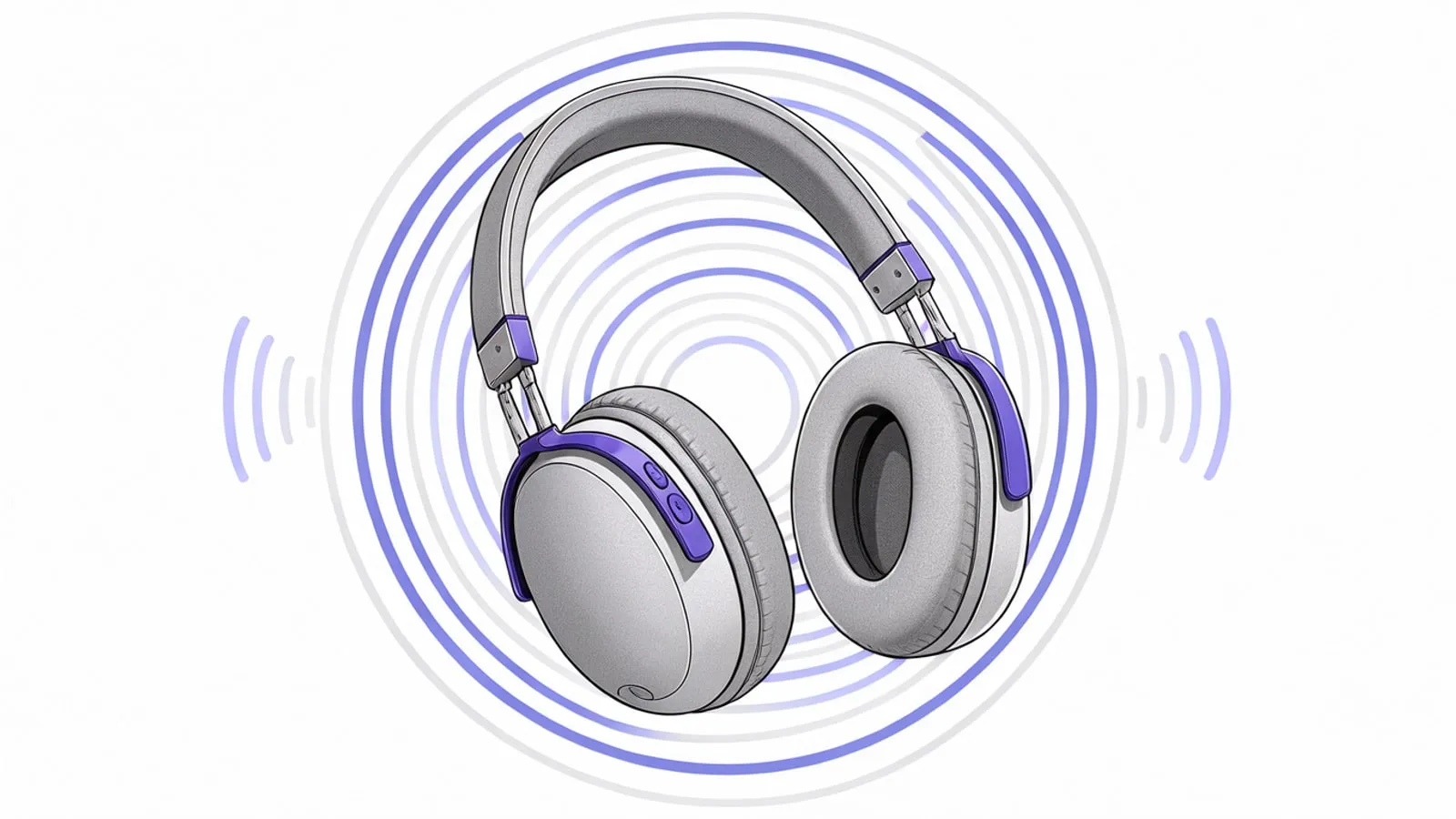
I bought these with my own money, on a Thursday, because my commute had become a bad podcast in a wind tunnel. Two weeks later they have replaced a pair of headphones that cost nearly twice as much, which is not a sentence I expected to write.
First impressions: the case is the surprise
Most flagship over-ears ship in a case that only fits if you fold them like origami and give up a water bottle. This one slides into the laptop sleeve of my 14-inch bag with room to spare, and the hinges feel like they will survive it.
Comfort is the other immediate win. Clamp force is gentle enough for a three-hour stretch without the temple ache that cheaper ANC headphones give you. If you wear glasses, the arms do eventually press — not painfully, but you will notice it at hour four.
Noise cancelling: the reason to buy these
I measured cancellation the boring way: a constant pink-noise source, a calibrated mic sealed against each cup, and the same 40-second clip for every pair.
| Headphones | Low rumble (50–200 Hz) | Speech band (500–2000 Hz) |
|---|---|---|
| Space One Pro | −31 dB | −24 dB |
| Bose QuietComfort (2025) | −33 dB | −25 dB |
| Sony WH-1000XM6 | −32 dB | −26 dB |
| Space One (2024) | −24 dB | −17 dB |
That table is the whole review. Within two or three decibels of the two best consumer ANC headphones on the market, for roughly half the money. The gap that used to exist between “cheap ANC” and “good ANC” has effectively closed at this price.
Sound: good, once you fix the bass
Out of the box the tuning is a bass shelf with treble sprinkled on top — fine for a train, tiring for an album. The app’s EQ is coarse but effective: I pulled 100 Hz down by 4 dB and nudged 2 kHz up by 2, and the result is neutral enough for eight hours of work.
Vocals sit slightly forward, which is ideal for podcasts and audiobooks. Imaging is decent for closed backs; you will not mistake it for an open pair, but instrument separation holds up in dense mixes.
Battery and daily annoyances
I logged 51 hours with ANC on and multipoint connected, against a 60-hour claim. That is honest engineering, not marketing maths.
Three small things bug me:
- The app asks you to create an account before it will remember EQ settings. You can skip it, but the prompt returns.
- Multipoint works beautifully between laptop and phone, yet switching audio focus takes about a second to recover after a call ends.
- The touch panel is a little too sensitive when you adjust the cups. I have skipped tracks by accident more than once.
Calls and microphones
In a quiet room, callers said I sounded “like a podcast host”. In a café, they said “audible but clearly a café”. Wind handling is average, and it does not compete with a boom mic — but for conference calls it is comfortably good enough.
Should you buy them?
If you want the best cancellation under £250, yes. These are the pair I would hand to a friend without a disclaimer, and the EQ fixes the one sound complaint that matters.
If accuracy is the job — mixing, mastering, reference listening — buy wired open-backs and a separate ANC pair for the commute. Nothing in this category is a monitoring tool.
The bottom line
At £199, the Space One Pro does the two things that actually matter — silence and comfort — at a level that used to cost £350. The bass shelf and the account nag are real, but neither survives ten minutes in the app. That is a 4.5 out of 5, and only the missing lossless codec keeps it from a clean sweep.